


From raw footage to intelligent action
VLA data operations turn complex video and motion footage into structured, model-ready datasets. Accurate segmentation, action labeling, and descriptive annotation help systems learn to connect vision, language, and movement.
Sourcefit builds scalable workflows with defined processes, measurable quality targets, and full project visibility. Our teams adapt to your tools, labeling standards, and accuracy goals so training remains consistent as projects evolve.
























Reliable and transparent VLA data operations
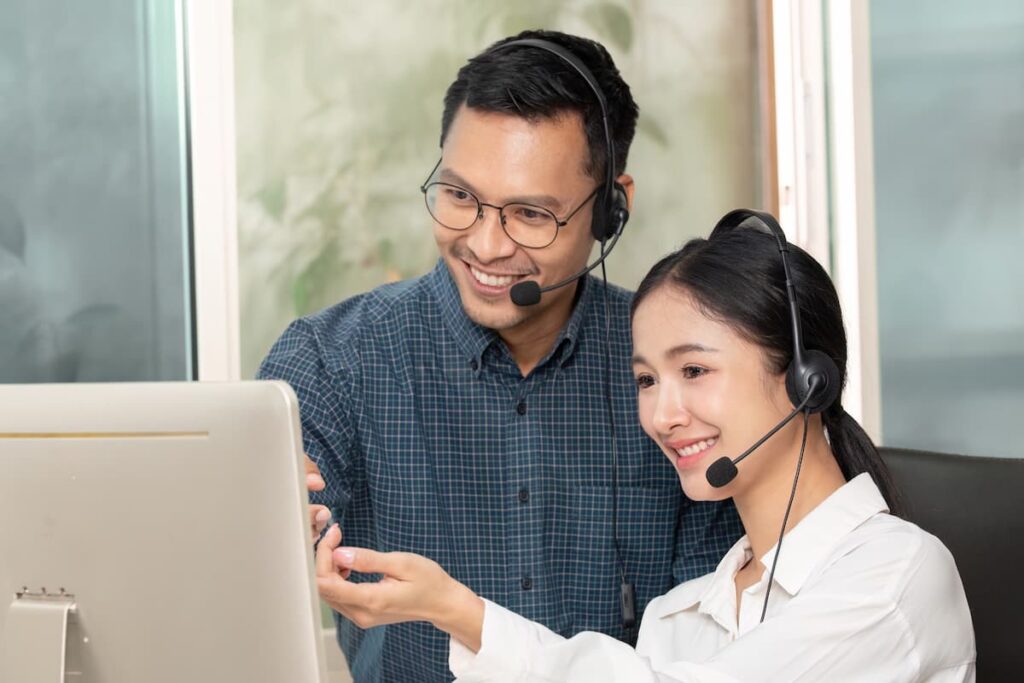
We provide flexible VLA data operations support that can scale from individual analysts to full project teams. Structured onboarding, clear labeling standards, and measurable quality checks maintain accuracy, throughput, and consistency. Client success managers and account oversight keep operations aligned and performance visible.
Our secure delivery centers and disciplined processes protect your data and IP. With 17 years of outsourcing experience and teams in the Philippines, South Africa, the Dominican Republic and Madagascar, Sourcefit provides VLA data operations outsourcing that is scalable, cost-efficient, and trusted worldwide.



Vision–Language–Action data operations services we provide

Video and motion annotation
Segment and label video footage to capture distinct robot actions such as pick, move, and place.

Object and action labeling
Identify and classify target objects and applied action verbs for each sequence.

Language description and captioning
Create clear natural-language captions summarizing actions, objects, and spatial context.

Performance and task evaluation
Tag sequences as success, sub-optimal, or failure to support model feedback.

Idle-time and event detection
Flag non-action or idle frames for efficient dataset management.

Outsourced annotation QA and documentation
Conduct accuracy reviews, maintain annotation guidelines, and manage documentation updates.










Gold Stevie Award winner for AI Innovation (2026) and HR Innovation (2025)
















Why companies choose Sourcefit for VLA data operations
Experienced data operations teams
17 years of experience supporting data, AI, and technology functions for global clients
Flexible engagement options
Cost-plus structure with transparent billing and adjustable scale
Structured QA and reporting
Layered review processes ensure accuracy and consistency across datasets
Secure and compliant operations
Certified facilities and strict data governance for full protection of sensitive data
Platform-aligned workflows
Teams integrate with your existing annotation tools and project systems
VLA data operations outsourcing pricing
Monthly rate per full-time employee, work from home. Office-based staff add $100 a month.
| Position requirement | Outsourcing |
|---|---|
 Entry |
$1,000 |
|
Mid
|
$1,355 |
|
Senior
|
$1,710 |
What the rate includes. Every rate above is all in. It is the employee’s salary and statutory benefits, passed through at cost and itemized on your invoice, plus our flat $395 management fee. The fee covers legal employment and an HR team on the ground, recruitment, an i5 computer with dual monitors and headset, 24/7 IT support and a secure managed network, security certifications and insurance, training and quality, client success management and the Knit workforce platform. There are no setup, recruitment, workstation, exit or team transfer fees. Where the work suits it, output-based pricing is also available, built on the same transparent framework with the unit price calculation shown.
That is typically 50 to 70 percent below the fully loaded cost of the same role in the US.
See the full rate card | What the management fee covers
Rates reviewed November 2026 by Andy Schachtel, CEO
Frequently asked questions
-
How much does VLA data operations outsourcing cost?
Sourcefit’s VLA data operations rates are $1,000 a month for entry level, $1,355 for mid level and $1,710 for senior VLA data analysts, per full-time employee working from home. Office-based staff add $100 a month. Each rate is all in: salary and benefits at cost plus the $395 management fee. There are no setup, recruitment or exit fees. Where the work suits it, output-based pricing is also available, built on the same transparent framework: we show how the unit price is calculated, so you know exactly what you are paying for.
-
Is the management fee added on top of these rates?
No. The fee is already inside every rate on this page and on every quote. A $1,000 rate is about $605 of salary and benefits at cost plus the $395 fee. You will never see the fee added to a rate you were quoted.
-
What is included in the monthly rate?
Legal employment and compliance with an HR team on the ground, recruitment, an i5 computer with dual monitors and headset, a 24/7 IT help desk, a secure managed network, our security certifications and insurance, training and quality, client success management and the Knit workforce platform. For office-based staff it also covers the seat, office network and utilities.
-
How quickly can Sourcefit build a VLA data operations team?
Most VLA data operations roles are recruited, interviewed and onboarded in two to four weeks. Calibration on your taxonomy adds one to two weeks before production volume. You interview and choose the VLA data analysts.
-
Who manages the team day to day?
That is your choice. Most clients manage the team directly: the VLA data analysts report to your managers and work inside your processes and tools, with Sourcefit handling employment, HR, equipment, IT and quality support behind them. If you would rather not manage day to day, our Sightline model builds an autonomous team with its own Sourcefit team lead and quality layer that delivers against agreed SLAs, while still reporting directly to you and working to your KPIs, not ours. Sightline is quoted separately.
-
Can the team work inside our existing systems?
Yes. VLA data analysts work in your annotation platforms, project dashboards and data formats, such as Label Studio, CVAT, custom tooling, RLDS or LeRobot exports, under your access rules. You keep ownership of every account, and access is revoked the day someone leaves.
-
Is VLA data operations outsourcing secure?
Sourcefit holds ISO 27001:2022 and ISO 27701 certification directly, is PCI DSS validated, has a SOC 2 report, signs HIPAA business associate agreements where needed and operates GDPR-aligned data handling. Home-based staff work on company-managed computers over a VPN with traffic routed through Cloudflare.
-
What happens if we want to bring the team in house?
The team is yours. If you decide to move them to your own entity or take them with you, they go with you. There is no transfer fee, buyout or conversion charge.
-
What is VLA data operations, and what does Sourcefit do?
Vision-language-action models learn from video of a robot or a person performing tasks, paired with language instructions and action labels. Sourcefit teams turn raw episodes into model-ready data: segmentation into sub-tasks, action and object labels, instruction and caption writing, success, partial and failure tags, idle and event detection, and QA. We annotate and validate data you collect; we do not operate robots or run teleoperation.
-
How is VLA annotation priced?
A dedicated analyst at a flat monthly rate with salary at cost and the management fee shown separately, or output-based pricing per episode for defined, high-volume work, built on a transparent framework with the calculation shown so you know exactly what you are paying for. Price per episode depends on video length, number of cameras and modalities, action granularity and QA layers.
-
Which VLA data tasks should stay with our robotics team?
Taxonomy and action-space design, embodiment definitions, collection on your hardware and policy evaluation. Everything downstream of collection, segmentation, labeling, language, outcome tags and QA, works well with a dedicated team trained on your taxonomy.
-
How do you measure accuracy for action and motion labeling?
Inter-annotator agreement against a gold set you own, with 95 percent or better on action labels as a common production threshold; language-to-action alignment checks; segmentation consistency; and per-episode scoring so weak sources can be excluded. New analysts complete a calibration battery before production.
-
How do you keep language annotations varied and precise?
Instructions are written against the video rather than copied from operator notes, with multiple phrasings per instruction type and atomic step boundaries, so the model learns to follow language instead of ignoring it. Your style guide for instructions is part of onboarding.
-
Can you label failures, partial successes and recovery, not just clean runs?
Yes. Outcome tags for success, partial and failure, missed grasps, wrong-object actions, contact moments and recovery segments are standard, because models trained only on successes do not learn recovery.
-
Can you work in our tools and data formats?
Yes. Analysts work in your annotation platform and dashboards and deliver in your format, including RLDS and LeRobot-style exports, with timestamp synchronization across modalities and embodiment metadata preserved.
-
How do you protect proprietary robot footage and trajectories?
Access only to your systems under named accounts, company-managed computers over a VPN, ISO 27001:2022 and ISO 27701 controls, IP assignment in the terms, and deletion terms at the end of a project. Consent documentation for human-demonstration footage stays with you.
-
With VLM auto-captioning, why do we still need human analysts?
VLMs pre-label and flag low-confidence frames cheaply, and they cannot say why an instruction and a scene do not match. Humans catch mismatched language, verify outcomes and review edge cases. Our analysts work AI-assisted queues, and the human share shifts to the hard cases as your automation improves.