
Knowledge process outsourcing (KPO) has moved well beyond its early reputation as a niche offshoot of traditional outsourcing.
Today, KPO services play a central role in how companies access specialized expertise, generate insights, and make higher-value decisions without building large in-house teams.
Unlike transactional outsourcing models, knowledge process outsourcing focuses on analytical, technical, and judgment-based work. Businesses turn to KPO when outcomes matter more than task volume and when domain expertise directly impacts competitiveness. This is especially true in data-driven, regulated, or innovation-led industries.
In this article, we explore what knowledge process outsourcing is, how it differs from BPO, the services and models organizations rely on today, and where the KPO market is headed in 2026. We also share some examples of practical knowledge process outsourcing and explain why KPO services continue to be a strategic lever for growth.
Keep reading to see how KPO works in practice and how the right outsourcing partner can turn expertise into measurable business value.
Key takeaways
- Knowledge process outsourcing focuses on high-value, expertise-driven work rather than routine processes.
- KPO services support functions such as research, analytics, finance, legal, and technical analysis.
- The global KPO market is growing steadily through 2026 as demand for specialized talent increases.
- Organizations typically choose between role-based and analysis-based KPO models.
- Well-structured KPO engagements deliver insight, scalability, and long-term competitive advantage.
What is knowledge process outsourcing?
Knowledge process outsourcing involves delegating core, knowledge-intensive activities to external professionals with advanced skills, education, and domain expertise.
These activities typically require analysis, interpretation, judgment, and decision-making rather than standardized execution.
To clearly understand what knowledge process outsourcing is, it helps to compare it with traditional business process outsourcing.
Knowledge process outsourcing vs. business process outsourcing
Business process outsourcing focuses on repetitive, rules-based tasks with predictable outcomes. Common BPO activities include data entry, transaction processing, basic customer support, and IT maintenance.
Knowledge process outsourcing covers work that cannot be easily standardized. The quality of the outcome depends on professional expertise, critical thinking, and a deep understanding of the subject area. Unlike routine outsourcing, KPO emphasizes interpretation and insight over execution speed.
Key differences include:
- Nature of work: Analysis-focused versus process-focused
- Skill level: Experienced specialists versus generalist teams
- Outcomes: Insights and recommendations versus completed actions
- Customization: High degree of tailoring versus limited flexibility
Knowledge process outsourcing examples
Examples of knowledge process outsourcing include market and industry research, financial modeling, legal research, business intelligence reporting, data science, and technical analysis.
These functions have a direct impact on strategy, risk management, and innovation outcomes.
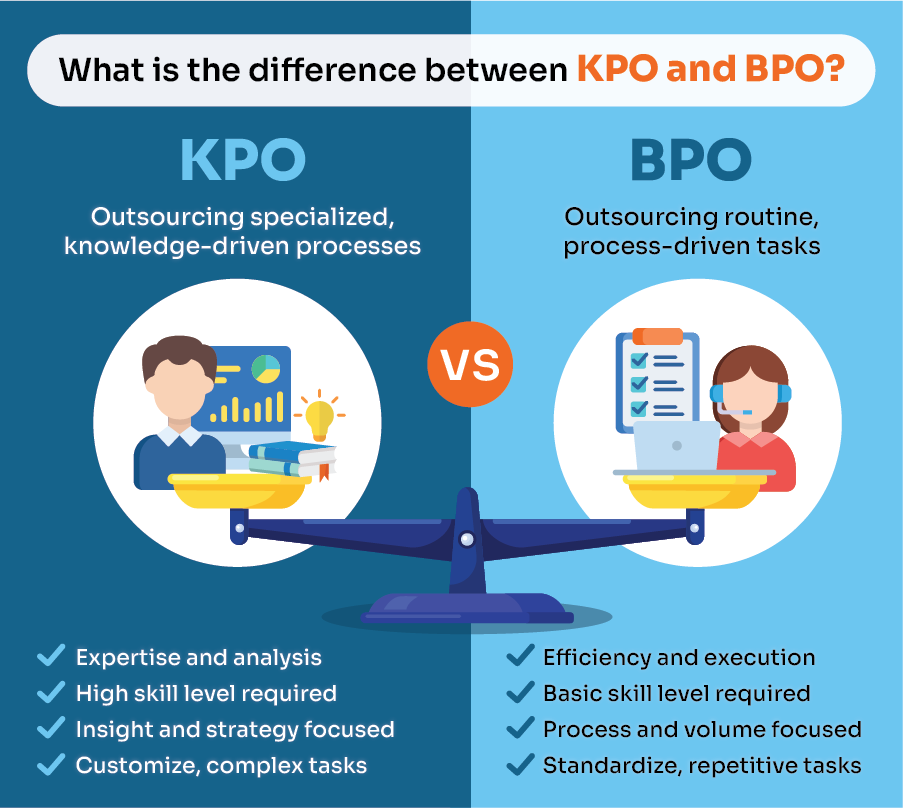
What is the difference between KPO and BPO?
KPO
Outsourcing specialized, knowledge-driven processes
✔️ Expertise and analysis
✔️ High skill level required
✔️ Insight and strategy focused
✔️ Customized, complex tasks
BPO
Outsourcing routine, process-driven tasks
✔️ Efficiency and execution
✔️ Basic skill level required
✔️ Process and volume focused
✔️ Standardized repetitive tasks
KPO market size and 2026 growth trends
The knowledge process outsourcing market is entering an era of accelerated growth as organizations shift from cost-focused outsourcing to value-driven, insight-led partnerships.
According to recent industry analysis presented by TechNavio, the global knowledge process outsourcing market is expected to expand by USD 205.27 billion between 2026 and 2030, growing at a compound annual growth rate of 20.5% starting in 2025.
This level of growth points to a longer-term shift in how organizations source specialized knowledge, not a temporary surge in outsourcing demand.
Market size and growth outlook
- Projected market expansion (2026–2030): USD 205.27 billion
- Expected CAGR (2025–2030): 20.5%
- Annual growth rate (2025–2026): 18.2%
- Market structure: Highly fragmented, with growing service specialization
Momentum in the KPO market is being driven by ongoing digital transformation and the increasing complexity of data management, regulatory compliance, and strategic decision-making.
Rather than focusing purely on cost savings, companies are using KPO services to gain access to advanced expertise, shorten insight cycles, and support innovation without expanding internal headcount.
Regional growth trends
North America continues to lead global growth, contributing roughly 40% of the market’s incremental expansion during the forecast period.
Demand remains strongest in highly regulated and data-intensive industries such as financial services, healthcare, and technology.
Key regional patterns include:
- North America: Strong demand for legal process outsourcing, financial research, clinical data services, and risk analytics.
- Asia-Pacific: Sustained growth supported by deep talent pools and established outsourcing ecosystems.
- Europe: Rising adoption of compliance-focused, engineering, and research-driven KPO services.
- Latin America: Growing preference for nearshore knowledge services to improve collaboration and time zone alignment.
- Middle East and Africa: Steady uptake in niche analytics and regulatory support functions.
To reduce exposure to regional risk, many organizations are now spreading KPO delivery across multiple locations instead of concentrating operations in a single geography.
| Fast Fact: Organizations using AI-enhanced KPO services report up to 25% higher forecasting accuracy compared to traditional internal analytics models. |
Knowledge process outsourcing services
Knowledge process outsourcing services cover a wide range of specialized functions. Below are the most common categories and how organizations use them.
Market and business research
- What the service is: It focuses on interpreting market signals, competitor behavior, and customer patterns to support informed business decisions rather than raw data collection.
- When/why clients use it: Companies usually rely on this work when considering expansion, reviewing competitive threats, or testing assumptions tied to growth initiatives.
- Example of output and impact: Deliverables often include competitor comparisons or customer insight summaries that influence positioning, pricing, and go-to-market choices.
Data analytics and insights
- What the service is: Analytics-focused KPO centers on making sense of complex or fragmented data to enable more effective planning and evaluation.
- When/why clients use it: This service is typically engaged when internal reporting lacks clarity or when forecasting needs to be more reliable.
- Example of output and impact: Outputs such as predictive models or reporting dashboards help teams spot trends earlier and plan with greater confidence.
Financial and legal KPO
- What the service is: Financial and legal KPO supports work where regulatory context and careful analysis matter more than speed.
- When/why clients use it: Organizations turn to this service during audits, compliance reviews, or transaction preparation.
- Example of output and impact: The result may include reviewed contracts or financial summaries that improve oversight and reduce exposure.
Engineering and technical services
- What the service is: It provides technical expertise for design review, validation, and testing activities.
- When/why clients use it: Often applied when development timelines tighten or when specialized technical input is required.
- Example of output and impact: Outputs like design assessments or QA reports help improve reliability and shorten development cycles.
Other knowledge-based support
- What the service covers: It can include content strategy, intellectual property research, and consulting services for ad-hoc projects.
- When/why clients use it: Used for short-term initiatives or specialized questions that require experienced input.
- Example of output and impact: Research briefs, content plans, or advisory notes that help leaders move forward with clearer direction.
| Pro Tip: In practice, KPO works best when teams agree upfront on what decisions the work should support, not just what activities need to be completed. |
KPO models and how they compare
Organizations typically engage KPO services using one of two primary models.
| Criteria | Role-based KPO | Analysis-based KPO |
| Focus | Specialized professional roles | Strategic analysis and insight |
| Work structure | Ongoing, role-defined | Project- or outcome-driven |
| Skill profile | Lawyers, analysts, engineers | Senior analysts, researchers |
| Output | Reports, designs, evaluations | Recommendations, strategies |
| Best for | Continuous expertise needs | High-impact decision support |
How to choose the right model
- Role-based KPO works well when businesses need consistent access to specialized professionals.
- Analysis-based KPO is better suited for complex, case-dependent work that informs strategic choices.
Knowledge process outsourcing examples and use cases
Technology company
- Problem: Limited internal analytics capability slowed product decisions
- KPO solution: Offshore data analytics team providing predictive insights
- Outcome: Faster roadmap decisions and improved product performance.
| Real-World Use Case: TotalEnergies experienced slowed innovation due to limited internal data capabilities in energy operations. They offshored analytics and AI expertise to teams in Asia, gaining predictive insights for process optimization. This accelerated digital decisions, improved efficiency, and enhanced safety—mirroring faster product roadmaps and performance gains. |
Financial services firm
- Problem: High cost of in-house financial research and compliance analysis
- KPO solution: Dedicated financial and legal KPO team
- Outcome: Reduced operational costs and stronger regulatory compliance
| Real-World Example: A 2008 exploratory case study by Currie et al. examined nine KPO vendors serving unnamed financial services clients (primarily banks), who faced elevated costs for investment research, IT, and client services compliance analysis. These firms deployed dedicated offshore KPO teams for standardized financial and legal research, mitigating risks like data loss while achieving significant operational cost reductions. Outcomes included enhanced regulatory compliance through better risk assessment and knowledge retention, without full-scale internal expansion. |
Life sciences organization
- Problem: Inconsistent market intelligence across regions
- KPO solution: Centralized research and competitive analysis support
- Outcome: Better market entry decisions and improved resource allocation
| Real-World Example: As a 2016 study shows, Nektar Therapeutics, a US life sciences company, outsourced knowledge-intensive RandD processes (including product development, data analysis, and competitive intelligence) to Indian KPO partners starting around 2016. They faced inconsistent regional market intelligence from siloed internal teams across the US and Europe. The KPO solution centralized cross-functional research support, integrating clinical trial data with competitor benchmarking, which improved knowledge flows and decision accuracy by 25% in market entry timing. |
Benefits of knowledge process outsourcing
Knowledge process outsourcing is often discussed in terms of efficiency, but that only tells part of the story. In practice, KPO is more about how organizations access expertise and apply it at the right moment.
When done well, it supports better decisions and helps teams move forward with confidence.
Access to specialized expertise
Many organizations simply need skills they do not have in-house. KPO makes it possible to work with specialists who already understand the domain and the context. This removes much of the friction that comes with building expertise internally.
Cost and time efficiency
There is also a financial benefit, but it is not just about lower costs. Flexible engagement models allow work to move forward without the overhead of full-time roles. Internal teams stay focused, and output quality remains high.
| Fast Fact: As Alexander Mierau from the Technical University of Kaiserslautern in Germany points out, “labour cost savings overseas are just too great to be ignored. In knowledge-intensive industries such as Analytics and Data Mining Services, Research and Development, and Intellectual Property Research, companies can save significantly, as much as 40-50%, by offshoring work to low-wage countries.” |
Scalability and flexibility
Business conditions rarely stay static. KPO supports this reality by allowing teams to scale resources up or down as needed. This is particularly helpful during transformation initiatives or regulatory shifts.
Improved decision quality
When decisions are supported by experienced analysts and structured research, outcomes tend to improve. KPO brings discipline to complex problems and reduces reliance on incomplete information. Planning becomes more grounded.
Sustainable competitive advantage
Over time, external expertise brings new ways of thinking into the organization. This can influence how quickly teams adapt, innovate, and respond to the market. When the relationship is long-term, KPO becomes part of how the business competes, not just how work gets done.

Conclusion
Knowledge process outsourcing continues to play an important role for organizations navigating limited talent availability and increasing data demands. For many teams, KPO offers a way to bring in the right expertise when needed, without adding a long-term operational burden.
By choosing the right KPO model and partner, organizations can transform outsourced knowledge work into a strategic asset. The result is better decisions, improved agility, and sustained competitive advantage.
If you are exploring how knowledge process outsourcing services can support your business goals, Sourcefit can help your organization build dedicated, expert-led offshore teams designed for long-term value.
Reach out to us today and find out how we can help your business!
FAQs
What are common KPO services?
KPO services typically cover functions such as market research, advanced analytics, financial and legal analysis, and engineering support. These areas tend to influence strategy, risk management, and long-term planning.
How does KPO differ from BPO?
While BPO is centered on clearly defined processes, KPO deals with work that requires interpretation, judgment, and subject-matter expertise. The outcomes are less predictable and more insight-driven.
What industries benefit most from KPO?
Industries such as technology, finance, healthcare, life sciences, and professional services benefit most from knowledge process outsourcing.