
By Andy Schachtel, CEO of Sourcefit | Global Talent and Elevated Outsourcing
If you want to hire someone in the Philippines without setting up a legal entity, you need an Employer of Record. The EOR becomes the legal employer on paper, handles payroll, taxes, benefits, and compliance, while you manage the person’s actual work. It is a model that has exploded over the past five years, driven by the rise of remote work and fueled by billions in venture capital flowing into platforms like Deel and Remote.
The result is a market with a lot of well-funded options and very little clarity about what you are actually paying for. Most EOR platforms charge $500 to $700 per employee per month on top of the employee’s salary and statutory costs. For that fee, you get a software dashboard and a legal entity in the Philippines that you will never visit. What you often do not get is a human being on the ground who knows the local labor market, can solve a problem in person, or can help you recruit and retain talent beyond just processing payroll.
I run Sourcefit, which operates EORganic, our Employer of Record division. We have been employing people in the Philippines since 2009 and have offices, HR teams, and IT infrastructure on the ground in Manila, Cebu, and Pampanga. That gives me a specific perspective on this market: I know what the tech platforms do well, and I know where they leave gaps that only a local operator can fill. What follows is an honest assessment of five EOR providers operating in the Philippines in 2026.
How We Evaluated
I assessed each provider on five dimensions. First, Philippines-specific infrastructure, because an EOR with a legal entity in the Philippines is not the same as an EOR with offices, HR staff, and recruitment capability here. Second, pricing transparency, because the EOR market is notorious for adding fees that are not visible in the headline rate. Third, compliance depth, because Philippine labor law has specific requirements around 13th month pay, SSS, PhilHealth, Pag-IBIG, and mandatory benefits that require genuine local expertise. Fourth, speed of onboarding, because some providers can have an employee on payroll in days while others take weeks. Fifth, what you actually get beyond payroll, because the best EOR providers in the Philippines offer support that goes well beyond processing a monthly salary.
At a Glance
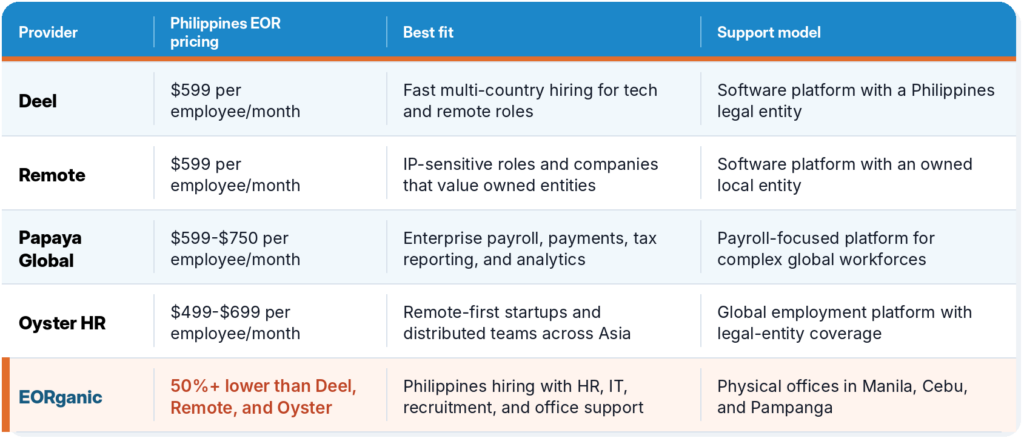
1. Deel
Deel is the most visible EOR company in the world right now, and for good reason. They have raised over $700 million in venture capital, operate legal entities in 150+ countries, and have built a software platform that makes hiring an international employee feel almost as simple as sending a Slack message. Their Philippines EOR service runs at $599 per employee per month, and they advertise two-day onboarding through their local entity.
Deel’s strength is speed and scale. If you are a technology company that needs to hire developers or remote workers across 10 countries simultaneously, Deel’s platform handles the complexity elegantly. Their dashboard, contract management, and payment infrastructure are best in class among the pure-play EOR platforms.
The limitation is that Deel is a software company, not a local employer. Their Philippine entity exists to process payroll and maintain legal compliance. There is no Deel office in Manila where your employee can walk in with a problem. There is no Deel HR team conducting onboarding in person or managing day-to-day engagement. For companies that view the EOR relationship as purely transactional, that is fine. For companies that want their Filipino team members to feel supported by a real organization on the ground, that gap matters.
2. Remote
Remote operates at a similar scale to Deel, with owned legal entities in 90+ countries and a $599 per month per employee price point for EOR services. Where Remote differentiates is in their emphasis on intellectual property protection. They own all of their entities rather than using third-party partners in some markets, which gives them a stronger legal position on IP ownership for the employees they hire on your behalf.
For companies hiring engineers, designers, or other roles where intellectual property is a critical concern, Remote’s owned-entity model provides an additional layer of protection that some competitors cannot match. Their platform is clean and well-designed, and their compliance infrastructure is solid across APAC.
The same fundamental limitation applies. Remote is a platform, not a local presence. Their value proposition is legal and technological, not operational. If your Filipino employee has a workplace issue, needs IT support, or wants to participate in local team activities, Remote’s platform does not address those needs. You are getting compliance and payroll, which is the core of what an EOR does, but not the human layer that makes the employment experience feel real.
3. Papaya Global
Papaya Global positions itself at the intersection of EOR and enterprise payroll, and their platform reflects that focus. At $599 to $750 per employee per month for EOR services in the Philippines, they are the most expensive option on this list. What you get for that premium is a sophisticated payroll engine that handles multi-currency payments, real-time tax reporting dashboards, and workforce analytics that enterprise finance teams appreciate.
Papaya’s three operating systems, Workforce OS, Payments OS, and their newer Contingent OS for freelancers and contractors, make them a strong choice for large companies managing a complex global workforce that includes a mix of full-time employees, contractors, and freelancers across multiple countries. Their analytics and reporting capabilities are genuinely ahead of most competitors.
The trade-off is cost and complexity. Papaya is built for enterprise buyers who need deep payroll infrastructure. If you are a growing company that wants to hire five people in the Philippines through an EOR, Papaya’s platform is more firepower than you need, and you are paying a premium for capabilities you may never use.
4. Oyster HR
Oyster HR covers 180+ countries and prices their EOR service between $499 and $699 per employee per month in the Philippines, making them slightly more affordable than Deel and Remote at the lower end of their range. They were named Best ROI for a global employment platform by G2 in 2026, which suggests their customers feel they are getting reasonable value relative to what they pay.
Oyster’s positioning is explicitly remote-first. Their platform is designed for distributed teams and includes features for managing global hiring, onboarding, and benefits administration from a centralized dashboard. For startups and remote-first companies that are building distributed teams across Asia and need a straightforward EOR solution, Oyster is a solid, well-regarded choice.
Like the other platforms on this list, Oyster’s Philippines presence is a legal entity, not an operational one. The same gap between platform and local support applies.
5. EORganic
EORganic is the Employer of Record division of Sourcefit, my company. I will be direct about the bias and equally direct about what makes EORganic fundamentally different from every other provider on this list.
The four companies above are technology platforms. They built software, established legal entities in dozens of countries, and process payroll through dashboards. That model works well for what it does. But what it does is limited to compliance and payments. EORganic starts where those platforms stop.
We have been operating in the Philippines since 2009. We have physical offices in Manila, Cebu, and Pampanga. We have local HR teams, local IT support, local recruitment capability, and a network of over 5,000 referral candidates. When you hire through EORganic, your employee is not just a record in a payroll system. They have access to real offices, real colleagues, real HR support, and a real employer brand that has been building its reputation in the Philippine labor market for 16 years.
Our pricing reflects the difference in model. EORganic runs more than 50% less than Deel, Remote, and Oyster because we are not burning through venture capital to acquire customers. We are an operating company, not a software company, and our cost structure reflects that. We also do not charge startup fees, recruitment fees, or require long-term contracts.
The honest limitation: we operate in five countries, not 150. If you need an EOR in 30 markets, Deel or Remote will serve you better. If you need an EOR in the Philippines, South Africa, the Dominican Republic, Madagascar, or Northern Ireland, and you want a partner that is physically present in those markets with real people and real infrastructure, EORganic was built for exactly that.
Choosing an EOR in the Philippines in 2026
The EOR market has matured rapidly, and the core product, legal employment and compliant payroll in the Philippines, is now available from dozens of providers. The question for buyers in 2026 is no longer whether EOR works. It is whether you want a software platform or a local partner.
The platforms are excellent at what they do. They are fast, they are scalable, and they make global hiring feel frictionless. But they are not employers in any meaningful sense beyond the legal paperwork. For some companies, that is all they need. For others, the difference between a dashboard and a person on the ground is the difference between a payroll arrangement and a real team.
To learn more about how EORganic provides employer of record services with local support and infrastructure in five countries, visit www.sourcefit.com/eor-services/ or contact our team for a consultation.