E-commerce outsourcing has moved from a cost-saving tactic to a strategic growth decision. In 2026, online retailers are under pressure to deliver fast, consistent, and personalized customer experiences while scaling operations without inflating overhead. This is where e-commerce outsourcing plays a significant role.
At its core, outsourcing for e-commerce means partnering with a specialized provider to handle selected operational, customer-facing, or technical functions. When done right, it improves customer experience while giving businesses the flexibility to scale up or down as demand shifts.
From customer support and order management to back office operations, e-commerce outsourcing services help brands stay competitive in a crowded market.
This article breaks down how e-commerce outsourcing works today, when it makes sense, which functions are most commonly outsourced, and what real return on investment looks like.
If you are evaluating whether to outsource part or all of your e-commerce operations, keep reading to make your decision easier.
Quick facts
- E-commerce outsourcing improves CX by providing faster response times and round-the-clock support
- Businesses can scale teams in days instead of months
- Outsourced teams reduce labor and infrastructure costs without sacrificing quality
- Full outsourcing e-commerce is becoming more common among mid-sized brands
- The right partner protects brand voice while improving operational efficiency
What is e-commerce outsourcing?
E-commerce outsourcing is a way for online retailers to offload selected operational tasks to a specialized provider.
By relying on external teams for execution-heavy work, companies can run leaner operations while maintaining consistency across customer-facing and back office functions.
Typical e-commerce outsourcing services include:
- Day-to-day customer support and CX activities
- Order and fulfillment-related processing
- Product data and content management
- Campaign support for digital marketing teams
- Technical and administrative operations
Instead of hiring, training, and managing in-house teams, companies gain access to ready-to-scale talent that integrates directly with their systems and processes.
Different types of e-commerce
E-commerce does not follow a single operating model. How a business sells online often determines which functions make sense to outsource and which are better kept in-house.
- B2C e-commerce focuses on selling directly to individual customers, which is common in industries like fashion, electronics, and consumer goods
- B2B e-commerce supports transactions between businesses, often involving longer sales cycles and account-based relationships
- C2C e-commerce refers to online marketplaces that allow individuals to buy and sell from one another
- C2B e-commerce enables individuals to provide products or services to businesses through digital platforms
Each model benefits from outsourcing in different ways, but all share the need for reliable CX and operational efficiency.
2025–2026 e-commerce outsourcing market stats and CX benchmarks
The global e-commerce outsourcing market continues to expand as online sales grow and customer expectations rise.
| Fast Fact: As Fortune Business Insights reports, the global business process outsourcing market reached USD 327 billion in 2025 and is projected to more than double by 2034, growing at a steady 9.7% CAGR. This rapid expansion reflects rising demand for specialized services, with e-commerce outsourcing playing an increasingly important role as online retailers look to scale operations and improve the customer experience. |
Key trends shaping outsourcing for e-commerce:
- Customer experience is now the top driver for outsourcing decisions, overtaking pure cost savings
- Average e-commerce response-time expectations have dropped below one hour for live channels
- Brands offering 24/7 support report higher repeat purchase rates than those limited to business hours
- Outsourced CX teams often outperform in-house teams on CSAT and first-contact resolution
These benchmarks highlight why outsourcing e-commerce operations is no longer optional for many growing brands.
When to outsource e-commerce operations
Deciding when to outsource e-commerce work is less about headcount and more about where the business is headed. The right moment often shows up when internal teams start feeling stretched.
Business growth stage
Early-stage companies often outsource to get to market faster without building large internal teams. Growing brands often use external support to keep up with rising order volumes, especially during seasonal spikes. Larger organizations, on the other hand, outsource specialized or overflow work to remain flexible and focus on more important processes.
Peak demand and seasonal spikes
Promotions and holiday sales can cause sudden increases in workload. Outsourced teams make it easier to scale support up or down as demand changes.
Talent gaps and skill shortages
E-commerce operations often require specialized knowledge that may not be readily available in-house. Outsourcing provides access to trained professionals without the delays of full-time hiring.
Need for 24/7 or multilingual support
Customers shop and reach out at all hours. Outsourced teams help ensure support is available across time zones and in multiple languages as demand grows.
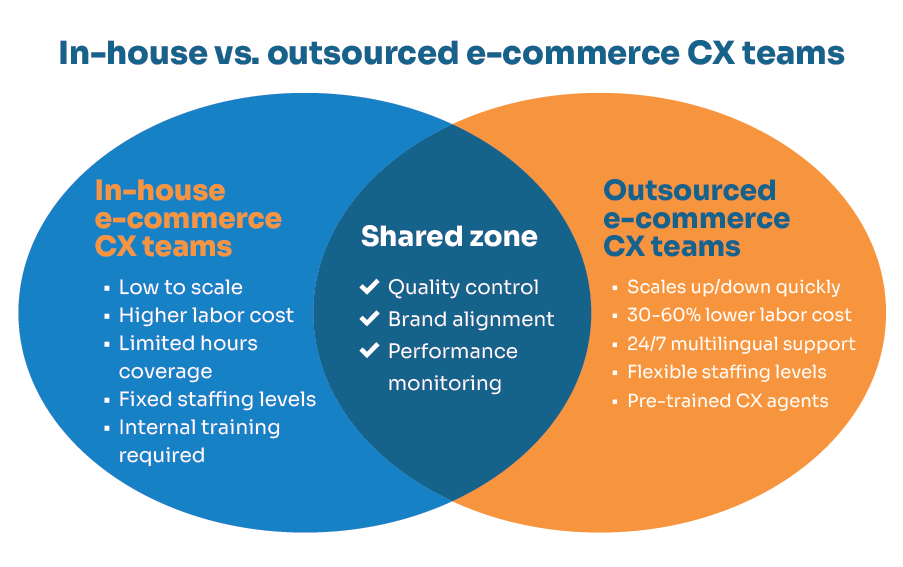
In-house vs. outsourced e-commerce CX models
Choosing between in-house and outsourced CX comes down to flexibility, cost, and performance.
| CX model | In-house team | Outsourced team |
| Setup time | Slow | Fast |
| Scalability | Limited | Highly flexible |
| Cost structure | Fixed | Variable |
| Coverage | Business hours | 24/7 |
| CX benchmarks | Varies | Consistent |
| Fast Fact: As experts from the National Institute of Industrial Engineering in Mumbai explain, “Outsourcing helps the organisation to achieve higher levels of value creation for the final customer. Drivers of outsourcing emanate from organisational initiatives, improvement focus, financial and cost objectives, or growth objectives”. |
Which e-commerce functions are commonly outsourced
E-commerce outsourcing works best when specific functions are clearly defined.
E-commerce customer support services
This includes voice, email, chat, social media, and review responses. Brands outsource CX to improve speed, consistency, and availability. Many partner with teams trained through dedicated customer service outsourcing programs.
Typical results:
- Faster response and resolution times across channels
- Higher customer satisfaction and repeat purchase rates
- Consistent brand voice during high-volume periods
- Improved coverage during nights, weekends, and holidays
Order management and fulfillment support
Outsourced teams handle order processing, tracking updates, returns, and refunds. This reduces errors and improves delivery-related customer satisfaction.
Typical results:
- Fewer order processing and fulfillment errors
- Faster handling of returns and refund requests
- Improved order visibility for customers
- Reduced internal workload during peak sales periods
Product catalog and content management
Managing SKUs, product descriptions, image tagging, and category updates is time-consuming. Outsourcing ensures accuracy and faster catalog updates across platforms.
Typical results:
- More accurate and up-to-date product listings
- Faster SKU setup and category updates
- Improved search and product discovery
- Better content consistency across marketplaces and regions
Digital marketing support
Email campaign execution, social media monitoring, and performance reporting are often handled externally to maintain consistent engagement without expanding internal teams.
Typical results:
- More consistent execution of campaigns and promotions
- Faster turnaround on email and social content updates
- Improved reporting and performance visibility
- Better alignment between marketing activity and sales cycles
Technical and back office operations
Payment reconciliation, fraud screening, and data validation are essential but resource-heavy. Many e-commerce brands rely on accounting outsourcing teams to handle these tasks and maintain accuracy and compliance.
Typical results:
- Improved data accuracy and reconciliation
- Faster identification of payment or fraud issues
- More reliable financial and operational reporting
- Reduced risk from manual processing errors

What ROI looks like with e-commerce outsourcing
Outsourcing e-commerce delivers measurable returns across multiple areas.
| Metric | Typical improvement |
| Labor costs | 30–60% reduction |
| CSAT | +10–25% |
| First-contact resolution | +15–20% |
| Team ramp time | 2–4 weeks |
| Productivity | Higher output per agent |
| Pro Tip: ROI improves fastest when outsourcing is tied to clear KPIs from day one, rather than vague cost targets. |
Steps for successfully outsourcing e-commerce
Before outsourcing e-commerce services, it’s important to consider various factors and take necessary measures. This will help you determine which tasks should be outsourced and how much time and money you can save.
To begin streamlining your e-commerce processes, follow these 3 steps:
Identify the tasks you need to outsource
Re-evaluate your e-commerce processes, including order management, product fulfillment, customer service, and back office support, and identify which of these tasks can be outsourced to a third-party service provider.
Check provider backgrounds
Verify the status, reputation, specialization, human resource capacity, and access to technology of potential third-party providers.
Also, ensure their capability to manage risks, protect systems, and combat security threats to prepare for unforeseen technical challenges.
Assess prices and plan your budget
Compare pricing levels across different outsourcing providers to select the right partner and service package that fits your needs and budget.
Then, draft a budget for e-commerce outsourcing services and establish a comfortable price for your outsourcing investment before proceeding.
Communicate your budget plan to potential partners and request pricing models that suit your needs and financial capabilities.
Outsourcing e-commerce: A success story
One successful example of outsourcing for e-commerce can be seen with the brand Adidas. In 2015, the company made a strategic decision to outsource its e-commerce operations to the technology provider, Demandware.
The move allowed Adidas to focus on its core competencies of product design and marketing, while Demandware handled the e-commerce platform, order management, and fulfillment.
Thanks to e-commerce outsourcing services, Adidas was able to reduce its website load time by 60% and increase website speed by 85%. In addition, the company saw a 27% increase in conversion rates and a 22% increase in mobile orders.
These improvements translated into a 59% increase in online sales for Adidas in the first quarter of 2016.
Why Sourcefit is the e-commerce outsourcing partner for you
Sourcefit delivers US-managed e-commerce outsourcing services with offshore teams based in the Philippines, the Dominican Republic, Armenia, and other countries. Clients benefit from experienced talent, strong English proficiency, and flexible team structures designed to scale with demand.
Whether you need partial support or a full outsourcing e-commerce model, Sourcefit builds dedicated teams aligned with your systems, brand voice, and long-term goals.
| Pro Tip: When evaluating e-commerce outsourcing partners, look beyond hourly rates. A US-managed delivery model with offshore teams often leads to faster onboarding, clearer communication, and better alignment with customer experience standards over time. |
Conclusion
E-commerce outsourcing in 2026 is about more than efficiency. It is about delivering better customer experiences while scaling sustainably.
Brands that outsource strategically gain flexibility, performance improvements, and cost control without compromising quality.
If you are ready to improve CX and scale faster, now is the time to explore e-commerce outsourcing services with a partner that understands your business.
Looking to scale your operations without sacrificing customer experience? Talk to Sourcefit about building a dedicated e-commerce outsourcing team tailored to your business.
FAQs
What services are included in e-commerce outsourcing?
Many businesses outsource a mix of customer support, order management, content maintenance, marketing support, and back office operations to keep e-commerce running smoothly.
What’s the difference between in-house and outsourced CX teams?
Compared to in-house teams, outsourced CX teams are often faster to scale and easier to adjust as volumes change.
Can outsourced teams maintain my brand voice?
Yes. With proper training and documentation, outsourced teams can closely match tone, policies, and customer standards.